- © COPYRIGHT 2026 ATEX-IECEx - ALL RIGHTS RESERVED
- PRIVACY POLICY
- TERMS AND CONDITIONS


Hazardous Area Training | IECEx CoPC Assessment | Competency Certification
Make an enquiry
Please fill out the form below, and we’ll get back to you to schedule your free initial consultation.
Working in explosive atmospheres needs proven skill. Guesswork is dangerous. If you handle electrical gear at Singapore’s oil and gas, marine, or chemical sites, IECEx Training and Certification proves you can do the job safely. The world recognizes it.
This guide is simple. It explains what IECEx training, certification, and the CoPC mean for you. You’ll learn who needs them. You’ll see which units matter most. You’ll learn how the process works. And you’ll know how to pick the right provider. By the end, you’ll know how to get certified and protect your career and your site.
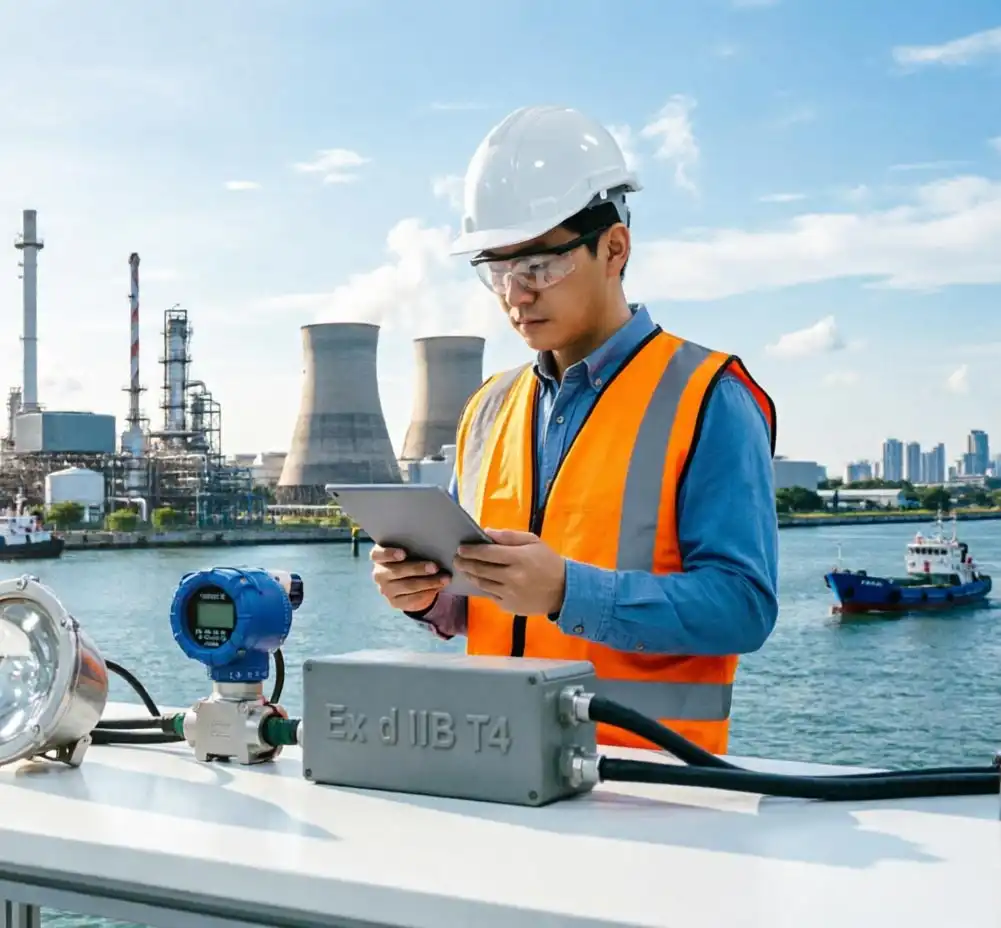
IECEx Training Singapore builds the skills you need for safe work in hazardous areas.
IECEx Certification Singapore proves that skill. An approved body runs a formal check.
The IECEx CoPC (Certificate of Personnel Competence) is the certificate you get after you pass. The world recognizes it.
Many Singapore employers in oil and gas, marine, chemical, and manufacturing want IECEx-qualified staff.
You must renew the IECEx CoPC every five years. You do this through a re-assessment.
IECEx Training and Certification is a clear path. It builds, tests, and proves your ability to work safely in hazardous areas. Training gives you the knowledge and hands-on skills. Certification confirms that skill through an independent check. The result is the IECEx CoPC. The world recognizes this certificate.
The IECEx System is the global standard for safety in explosive atmospheres. It covers equipment, services, and people. For people, the CoPC Scheme checks how well you apply your skills. It tests you against detailed international rules.
This matters in Singapore. So much industrial work happens in or near hazardous zones. Look at the sites on Jurong Island. Look at the refineries at Pulau Bukom. Look at the marine and offshore yards in Tuas. They all need workers who understand explosion protection aspects. IECEx gives workers and employers one trusted benchmark.
Here’s the simple difference:
Picture an instrument technician on Jurong Island. They take IECEx training to learn how to maintain flameproof equipment. Then they pass the assessment. They get a CoPC for that unit. Their employer can check it online before sending them to live work.
Do you install, maintain, inspect, repair, or supervise electrical equipment in hazardous areas? If so, you should hold IECEx certification. This applies to hands-on technicians as well as the managers who oversee them.
If your role involves Ex-classified zones, certification may apply to you. The IECEx Certificate of Personnel Competence (CoPC) Scheme is modular, so you only certify for the units that match your actual job responsibilities.
Roles that commonly require IECEx training and certification include:
Match the certification unit to the task—not the job title. For example, an electrician who installs Ex wiring needs different competency units than an inspector. Mapping roles to the correct units first saves time and reduces unnecessary training costs.
A facilities team at a chemical plant near Jurong Island followed this approach. Supervisors completed installation and inspection units, while frontline technicians completed maintenance units. Each employee was certified only for the work they performed on site.
IECEx competency is needed across Singapore’s high-hazard sectors. These are places with flammable gases, vapors, or dusts. These industries drive much of the country’s economy.
Hazardous areas show up wherever fuels, solvents, or fine combustible materials are processed, stored, or moved. Singapore packs many of these activities into well-known industrial hubs.
Sectors that rely on IECEx competency include:
Jurong Island holds one of Asia’s largest petrochemical clusters. Many process units sit closely together, so installation, maintenance, and inspection of Ex equipment is continuous. This also drives ongoing demand for IECEx-certified personnel.
For more on Singapore’s industrial landscape and economic initiatives supporting these sectors, visit the Singapore Economic Development Board (EDB).
See how ATEX-IECEx supports IECEx competency across Singapore's industries.
The IECEx CoPC (Certificate of Personnel Competence) is a globally recognized certificate. It confirms you have been assessed as competent for specific hazardous-area tasks. In Singapore, it is one of the clearest ways to demonstrate Ex skills to employers, clients, and auditors.
A CoPC is not simply a record of training attended. It is issued only after an approved IECEx Certification Body (ExCB) verifies both theoretical knowledge and practical competence. Once issued, it is published in the public IECEx online certificate system, where it can be verified by anyone.
Here’s what makes the CoPC valuable:
Do not confuse a training certificate with a competence certificate. Training from an IECEx Recognised Training Provider prepares candidates for assessment, but only a successful evaluation by an ExCB results in a CoPC.
For example, an offshore subcontractor operating from Tuas provided a verifiable CoPC before mobilization. The asset owner confirmed the certificate online within minutes, allowing work to proceed without delay.

IECEx Training and Certification in Singapore align with the standards set by the International Electrotechnical Commission (IEC), the global organization responsible for developing international electrical and safety standards.
The IEC 60079 series, which governs explosion-protected equipment and hazardous area classifications worldwide, forms the technical basis for the IECEx CoPC Scheme. This ensures that personnel certified under IECEx meet rigorous, globally accepted safety requirements for working in explosive atmospheres.
By adhering to IEC standards, IECEx training provides professionals with the knowledge and skills necessary to comply with international regulations and industry best practices, enhancing safety and operational reliability in hazardous areas.
These three terms are linked but different. Training builds skills. Certification proves them. The CoPC is the certificate that confirms competence. Understanding the difference helps you choose the right path and avoid unnecessary costs.
Many people use these terms interchangeably, which often leads to confusion. The table below clearly explains the difference.
| Feature | IECEx Training | IECEx Certification | IECEx CoPC |
|---|---|---|---|
| Purpose | Build knowledge and skills | Validate competency | Official proof of competency |
| Includes assessment | Sometimes | Yes | Yes |
| International recognition | No | Yes | Yes |
| Employer requirement | Often | Yes | Yes |
In short:
A client asking for “IECEx certified” workers is usually referring to a valid CoPC. It is important to confirm this early so you can align certification to the correct units.
One contractor once sent technicians for a hazardous-area course, only to discover the client required a CoPC instead of a course certificate. Verifying requirements upfront would have avoided a second round of assessment.
The IECEx path in Singapore follows clear, step-by-step stages from eligibility through to renewal. Understanding each step helps you plan time, budget, and personnel effectively.
The process is governed by the IECEx CoPC Scheme and IECEx operational documents. Here’s how it works:
Start by mapping your job tasks to the correct IECEx units. This single step determines your training plan, assessment scope, and overall cost.
Do not book training before confirming your units. Otherwise, you risk being certified for tasks you do not perform—or missing a unit required by your client.
A maintenance team on Jurong Island first mapped roles before training. They then completed assessments together, allowing the entire team to stay certified on a coordinated schedule.
The CoPC Scheme uses a set of modular units. A few matter most for Singapore’s installation, maintenance, and inspection work. You only certify for the units that match your tasks.
Each unit covers a defined scope of competence. The most requested units in Singapore’s industries are listed below.
| Unit | Scope of competence |
|---|---|
| Ex001 | Apply basic principles of protection in explosive atmospheres |
| Ex003 | Install explosion-protected equipment and wiring systems |
| Ex004 | Maintain equipment in explosive atmospheres |
| Ex005 | Overhaul and repair of explosion-protected equipment |
| Ex006 | Test electrical installations in or associated with explosive atmospheres |
| Ex007 | Perform visual and close inspection of electrical installations |
| Ex008 | Perform detailed inspection of electrical installations |
A quick way to understand the grouping:
An inspection contractor serves petrochemical clients on Jurong Island. It put Ex007 and Ex008 first for its inspectors. Visual, close, and detailed inspections are central to their daily work.
Are you ready to become IECEx certified?
Contact atex-iecex to start your IECEx Training and Certification in Singapore.
IECEx training time in Singapore depends on two main factors: the units you select and your prior experience. Foundational units usually take less time, while installation, maintenance, and inspection units require more days because they include both theory and hands-on practical work.
The scheme is modular, so there is no fixed duration. A basic awareness unit is shorter than a combined installation and maintenance pathway. Training is always followed by a separate assessment, which also adds to the overall timeline.
A few factors affect the total duration:
Certifying related units together—such as installation and maintenance—can often be more time-efficient than spacing them out across separate sessions.
A plant team near Tuas grouped technicians by role and ran combined training and assessment schedules. This reduced repeat mobilization and helped maintain operational continuity on site.
IECEx training fees in Singapore vary depending on the number of units selected, group size, and the level of practical assessment required. Each training path is designed around specific job roles, so costs are best confirmed through a tailored quote.
There is no fixed industry rate. Pricing changes based on scope. A single foundational unit costs less than a multi-unit pathway that includes extensive practical assessment. Group bookings can also affect the per-person cost.
Cost usually depends on:
Do not rely on generic pricing. Instead, request a quote based on your actual units and team size. This ensures a realistic budget and prevents paying for unnecessary modules.
A contractor supporting offshore projects requested a tailored quote for a mixed team of installers and inspectors. They prioritized the units required for their immediate project needs, optimizing both cost and training time.
Choose an IECEx training provider in Singapore by focusing on four key factors: accreditation, trainer experience, practical facilities, and assessment readiness. The right provider prepares you to pass the formal CoPC assessment—not just complete a course.
Quality varies significantly between providers. The strongest programs are built directly around the CoPC Scheme and reflect real working conditions in Singapore’s industrial environments.
Use this checklist when comparing providers:
Do not choose based on price alone. A lower-cost course may leave gaps in assessment readiness, which can increase overall cost later.
Ask each provider how they connect training to certification. A clear, confident answer usually indicates they understand the difference between attendance and competency.
A petrochemical operator on Jurong Island shortlisted several providers based on trainer experience and facilities. They selected the one that aligned training directly with the specific units required for their workforce.
Professionals choose ATEX-IECEx (Kingsmen Certification and Inspection Services) for a reason. The team combines deep explosion-protection expertise with a practical, assessment-focused approach. ATEX-IECEx specializes in ATEX, IECEx and UKCA with strong knowledge of what real hazardous-area competency requires.
The focus is real-world readiness. Training prepares technicians, engineers, and supervisors for live Ex environments—not just for a certificate on paper.
What sets ATEX-IECEx apart:
Industries ATEX-IECEx supports in Singapore include:
Teams across Jurong Island, Pulau Bukom, and Tuas require certified personnel who can pass formal assessments and perform safely under real operational pressure. ATEX-IECEx prepares them for both.
Take the Next Step Toward IECEx Certification
IECEx Training and Certification gives Singapore professionals a clear way to demonstrate competence in hazardous-area work. It is internationally recognized and widely accepted across industries. The process begins by matching your role to the appropriate units, followed by structured training and assessment through an approved body. Once certified, the CoPC must be kept current through reassessment every five years. When done properly, this helps protect facilities, satisfy client and auditor requirements, and strengthen professional careers.
The simplest next step is to speak with a specialist who can map the correct units to your team and develop a practical certification plan.
What is IECEx Training in Singapore?
IECEx Training in Singapore prepares personnel who work in hazardous areas. It teaches how to apply explosion-protection principles safely in real environments. The training builds both theoretical knowledge and practical skills for tasks such as installation, maintenance, and inspection. Training is the preparation stage, followed by a formal assessment that leads to the IECEx CoPC.
What is the difference between IECEx Training, IECEx Certification, and IECEx CoPC?
Training builds your knowledge and skills. Certification validates those skills through a formal assessment conducted by an approved IECEx Certification Body. The CoPC is the official certificate issued after you pass. It is globally recognized. In short: training prepares you, certification assesses you, and CoPC confirms your competence.
Who needs IECEx Certification in Singapore?
Anyone who installs, maintains, inspects, repairs, or supervises electrical equipment in hazardous areas should hold IECEx certification. This includes plant managers, maintenance engineers, instrument technicians, electrical supervisors, and oil and gas contractors working at sites such as Jurong Island, Pulau Bukom, and Tuas.
Which IECEx Units are most commonly required in Singapore?
The most commonly required units are Ex001 (basic principles of protection), Ex003 (installation), Ex004 (maintenance), Ex005 (overhaul and repair), Ex006 (testing), Ex007 (visual and close inspection), and Ex008 (detailed inspection). Certification is only required for the units that match your job role.
How long does IECEx Training and Certification take in Singapore?
Duration depends on the number of units, your experience level, and the balance between theory and practical work. Foundational units are shorter, while combined installation, maintenance, or inspection pathways take longer. Assessment is scheduled separately. For an accurate timeline, request a tailored plan from ATEX-IECEx.
What are the eligibility requirements for IECEx CoPC?
Eligibility depends on the selected unit. Each unit has specific competency requirements covering both knowledge and practical skills. The recommended first step is to match your job tasks to the relevant units and then confirm entry requirements with your certification provider.
Is IECEx Certification recognized internationally?
Yes. The IECEx CoPC is recognized across IECEx member countries worldwide. Once issued, your certificate is published on the public IECEx online certificate system, allowing employers and clients to verify your competence globally.
Can electricians and technicians apply for IECEx CoPC in Singapore?
Yes. Electricians, instrument technicians, and other skilled workers can apply. Certification is based on the units relevant to their job tasks. General electrical experience alone is not sufficient for hazardous-area work, as the IECEx assessment evaluates specific Ex knowledge and practical competence.
How often does IECEx CoPC need to be renewed?
The IECEx CoPC requires reassessment every five years to maintain validity. This ensures your competence remains aligned with updated international standards and industry practices.
How do I choose the right IECEx Training provider in Singapore?
Choose a provider with accreditation aligned to the CoPC Scheme, experienced trainers, strong practical facilities, and clear assessment support. Avoid selecting based on price alone. ATEX-IECEx offers experienced instructors and assessment-focused training designed for Singapore’s industrial sectors.
We are a consultant for ATEX – IECEX Product and System Certification, Coordinating with Testing Laboratory and Inspection Body. We collaborate with ATEX Notified Body and an IECEx Certification Body and Test Laboratory. All of our projects are internationally recognized for global markets and we also issue necessary quality system certification for ATEX, IECEx.
Contact Us