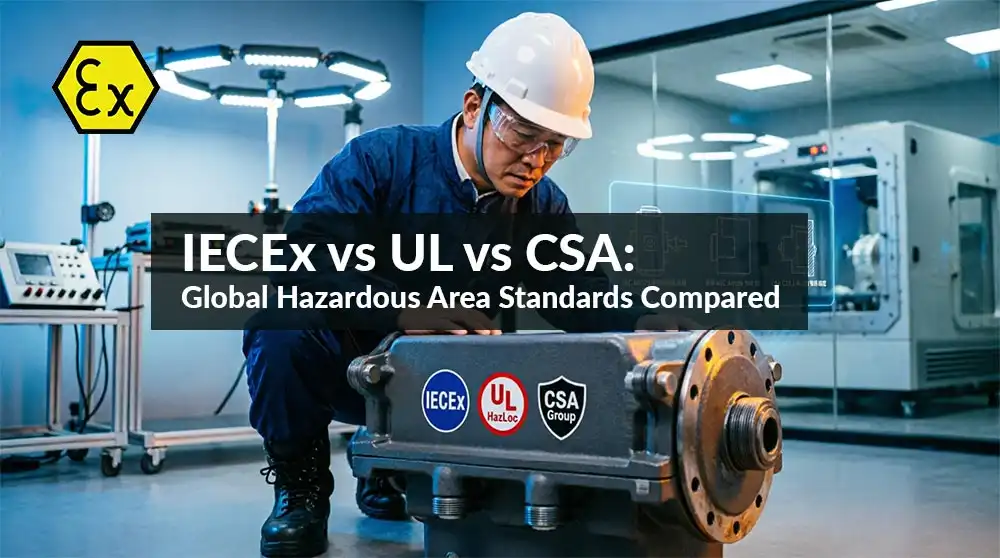
IECEx, UL, and CSA are three different certification standards for hazardous area equipment. IECEx is accepted in the Middle East, Europe, Asia, and Australia. UL is required in the US. CSA covers Canada. They are not interchangeable — having one does not mean you can skip the others.
If you export hazardous area equipment, this difference matters. Choose the wrong standard and you could face rejected shipments, project delays, or costly re-certification.
Why Do Hazardous Area Standards Differ by Region?
Different countries have different rules. There is no single global certificate that covers every market.
Equipment used in explosive or flammable environments — like oil refineries, gas plants, or chemical facilities — must meet local safety requirements. Each region has its own governing body and its own accepted standard.
That is why IECEx vs UL certification is not just a technical question. It is a market-access question. Get it right before you export, not after.
What Is IECEx Certification?
IECEx stands for the International Electrotechnical Commission System for Certification to Standards Relating to Equipment for Use in Explosive Atmospheres.
It is run by the International Electrotechnical Commission (IEC) — a global body. IECEx is based on the IEC 60079 series of standards.
It is accepted in 50+ countries, including the UAE, Saudi Arabia, Qatar, Oman, Kuwait, Bahrain, Europe, Asia, and Australia.
For GCC-based manufacturers and exporters, IECEx is your primary certification. Most oil and gas projects in the Middle East specify it by name.
Want to learn more? Visit our complete IECEx certification guide.
What Is UL Certification for Hazardous Areas?
UL stands for Underwriters Laboratories. It is a US-based safety certification organization.
UL hazardous area certification is based on the National Electrical Code (NEC) and NFPA standards. These are the rules that govern the US market.
If you want to sell hazardous area equipment in the United States, you will need UL certification.
Outside the US, UL is generally not accepted. Middle Eastern, European, and Asian buyers will not accept a UL mark in place of IECEx or ATEX.
What Is CSA Certification?
CSA stands for Canadian Standards Association. It is the primary hazardous area standard for Canada.
CSA is accepted in Canada and some parts of North America. Like UL, it was built for a domestic market — not for global use.
If you sell into both Canada and the US, you may need both CSA and UL. Neither replaces the other. And neither replaces IECEx for international markets.
IECEx vs UL vs CSA: Standards Comparison Table
| Standard | Governing Body | Primary Region | Recognition Scope |
| IECEx | International Electrotechnical Commission (IEC) | Middle East, Europe, Asia, Australia | 50+ countries globally |
| UL (NEC/NFPA) | Underwriters Laboratories / NFPA | United States | US-focused; not widely accepted internationally |
| CSA | Canadian Standards Association | Canada / North America | Canada-primary; limited international recognition |
The key point: IECEx is designed for international use. UL and CSA were primarily developed for their respective home markets.
Are IECEx, UL, and CSA Interchangeable?
No. They are not interchangeable.
An IECEx certificate does not get you into the US market. A UL mark will not satisfy a GCC or European buyer. A CSA mark does not work in the Middle East.
Each standard has its own testing process, its own certification body, and its own rules. There is no automatic crossover between them.
That said, IECEx and ATEX share the same technical base — the IEC 60079 series. So in some cases, test data from one can support the other. This depends on your certification body and your product.
Not sure how ATEX fits into this? Read our article on ATEX vs IECEx: key differences and why they matter.
Which Certification Do You Need for Your Target Market?
It depends on where you sell and what your buyers require.
- Middle East, Europe, Asia, Australia → IECEx (sometimes ATEX for EU-specific projects)
- United States → UL
- Canada → CSA
- Multiple regions → You may need more than one
Always check your buyer’s project specifications. In oil and gas, the required standard is often listed by name. If they ask for IECEx, a UL mark will not work.
How to Plan a Multi-Market Certification Strategy
Follow these steps to build the right certification plan for your export goals.
- List your target markets. Write down every country or region you sell into — or plan to enter.
- Find out which standard each market accepts. Middle East and Europe need IECEx. The US needs UL. Canada needs CSA.
- Check your buyer contracts. Project specs often name the required standard. Do not assume — verify.
- Talk to your certification body early. If your product already meets IEC 60079, some markets may accept shared test data. Ask your ExCB what is possible.
- Plan ahead for growth. If you plan to enter North America in two or three years, start building UL or CSA into your product cycle now. It costs less than retrofitting later.
- Work with a specialist consultancy. Multi-market certification is complex. A good consultancy keeps things on track and reduces duplicate costs. Learn how to choose the right IECEx certification body (ExCB).
What Happens If You Get the Wrong Certification?
The risks are real.
If you sell into a market without the correct certification, your shipment can be delayed or blocked. In oil and gas, non-compliant equipment can be rejected at the project site — even after it clears customs.
In the UAE, Saudi Arabia, and Qatar, regulators now check IECEx compliance at the point of installation — not just at the border. That means a product can pass customs and still get rejected on-site.
If you then need to re-certify for that market, you pay twice. You cover the cost of the original certification, plus the new one — including retesting and possible product changes.
The smarter approach: plan your certification around your full export map from the start. See how a structured pathway works on our IECEx certification process page.
Also worth noting: ATEX and IECEx are closely related but not the same. Some GCC buyers accept ATEX as a quality signal, but it does not meet the formal IECEx requirement. Check whether your buyers specify IECEx specifically.
If you supply as an importer or distributor — not a manufacturer — the certification rules are different. Our guide on IECEx certification for manufacturers vs importers and distributors explains what applies to you.
How ATEX-IECEx (Kingsmen Group) Supports Global Market Access
At ATEX-IECEx, part of Kingsmen Group, we help manufacturers and exporters across the UAE, Qatar, Saudi Arabia, and India build the right certification strategy for their markets.
We know how IECEx, UL, and CSA work. We know which markets require which standard. And we help you plan across all of them — without paying for more than you need.
Our team guides you through the full process — from gap analysis and documentation to certification body coordination and readiness support.
Planning to export to multiple regions? Talk to our team about a multi-market certification strategy.
FAQs
Is IECEx accepted in the UAE and GCC countries?
Yes. All six GCC countries accept IECEx — UAE, Saudi Arabia, Qatar, Oman, Kuwait, and Bahrain. Most oil and gas projects in the region require it. UL and CSA are not accepted instead of IECEx in these markets.
Can I use a UL certificate instead of IECEx?
No. UL is for the US market. It is not accepted in the Middle East, Europe, or Asia. If your buyer asks for IECEx, a UL mark will not meet that requirement.
Do I need separate certification for the Middle East and North America?
Yes. You need IECEx for the Middle East and UL or CSA for North America. These are different schemes. One does not cover the other.
Is IECEx recognized in the US?
No. The US uses UL and follows the NEC/NFPA framework. IECEx is not a recognized compliance path for the US market. If you want to sell in the US, you need UL certification.
Can IECEx certification help with ATEX for the EU?
Sometimes. Both IECEx and ATEX use the IEC 60079 series as their technical base. In some cases, test reports from IECEx can support an ATEX application. Talk to your certification body before you start — it depends on the product and the certifier.
How long does IECEx certification take?
It usually takes three to six months. The timeline depends on your product’s complexity, how ready your documents are, and how quickly your ExCB can work. Starting with good documentation saves time.