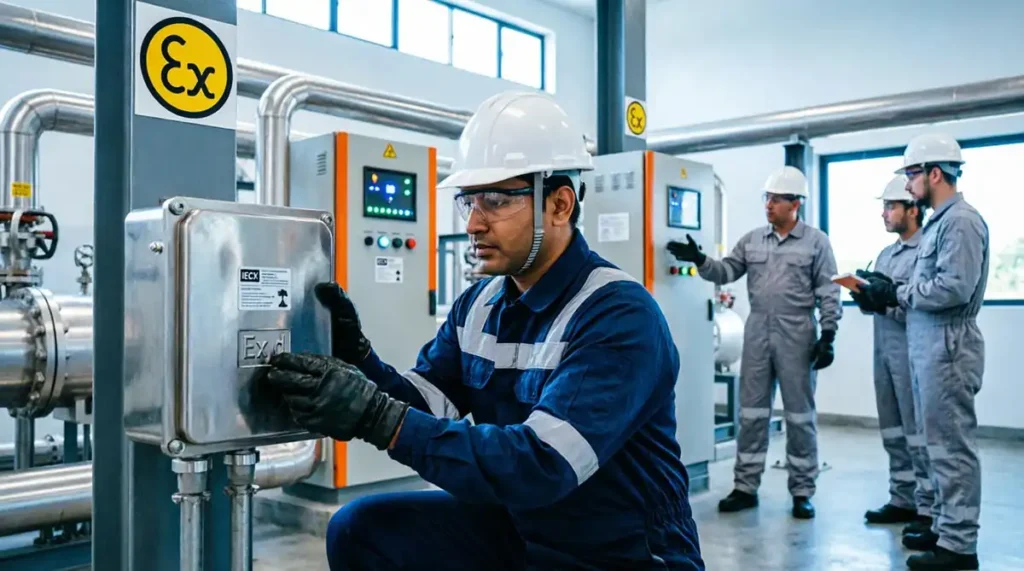
IECEx Training teaches you to work safely in explosive zones. These zones hold flammable gas, vapor, or dust. You find them in oil and gas plants worldwide. In the UAE, offshore rigs and refineries depend on this skill.
The training follows global IEC standards. It proves you can handle hazardous areas the right way. It also proves you can protect gear from sparks and blasts.
This post covers what the training means. It shows who needs it and how to earn the certificate. You will also see the career value it brings.
What is IECEx Training?
IECEx Training is a skills program for hazardous area work. It teaches you to handle explosion-proof gear the safe way. The program follows IEC standards for explosion protection.
The training covers three core areas:
- Hazardous area classification — how to read Zone 0, Zone 1, and Zone 2
- Explosion protection — safe methods like flameproof and intrinsic safety
- Equipment selection and checks — pick the right gear and keep it safe
The program sits inside the wider IECEx System. That system also tests gear and labs. Oil and gas firms trust it as the global mark of skill.
In short, IECEx means safe work near gas that can ignite. The training builds real skill in electrical safety compliance.
Why IECEx Certification is Required in High-Risk Industries
High-risk plants share one danger. They hold gas or vapor that can ignite. One spark can trigger a blast. So the rules stay strict.
IEC standards say workers in these zones must prove their skill. IECEx certification gives that proof. Without it, you cannot do the work.
In the UAE, big firms set this rule hard. ADNOC and its units want certified staff on all Ex jobs. A worker without it fails the permit-to-work check. That means no site access and no pay.
Picture a real case. A flameproof box sits in a Zone 1 area in Ruwais. Its seal is broken. Gas reaches the spark inside. The guard is gone, and the blast follows.
This is why firms screen for the skill first. They check your certification before they hire you. It is a hard rule, not a bonus. It keeps people and plants safe.
Miss the certification, and the cost is high. You lose site access. Projects stall. The firm faces legal risk. So the safe path is clear.
IECEx Training Modules Breakdown
The training breaks into clear modules. Each one builds on the last. Here is what you learn:
✅ Electrical safety in explosive zones — voltage risk, arc flash, and safe shutdown steps
✅ Gas and vapor hazard zones — how to define Zone 0, 1, and 2 and read zone maps
✅ Equipment selection rules — match the right gear to each zone and gas group
✅ Inspection and maintenance — how to check Ex gear and log faults the right way
The order matters here. You cannot pick gear without knowing the zone. You cannot check gear without knowing its guard method. So the modules run in sequence by design.
Each module ends with a skill check. That check confirms you can apply the rule on site. This keeps the training tied to real work.
IECEx Certification Process
The process runs in five clear steps. Each step moves you closer to your certificate.
- Eligibility check — confirm you meet the skill and work needs for your level.
- Training enrollment — join a course from an approved IECEx provider.
- Technical modules — finish all units on zones, protection, and gear checks.
- Practical evaluation — show your hands-on skill with real Ex gear.
- Certificate issuance — pass both tests and earn your IECEx certificate.
Your certificate then goes into the public IECEx database. Any employer can verify it online. This adds trust and speeds up hiring.
IECEx Certificate Explained
IECEx Certificate: A global credential that proves you can work safely with explosion-proof gear in hazardous zones, in line with IEC standards.
The certificate proves three things to a firm:
- You understand hazardous area classification.
- You can select, fit, and check Ex gear to IEC standards.
- An assessor tested your skill. You did not self-declare it.
Who issues it?
Approved IECEx bodies issue the certificate. They work under the IECEx System, run by the IEC. Each certificate lands in the official public database.
Global acceptance:
The certificate holds value in over 50 countries. That list covers the UAE, Saudi Arabia, Qatar, and Australia. One certificate lets you work across most global markets. You skip repeat tests in each new country.
IECEx vs ATEX Certification
| Factor | IECEx | ATEX |
| Geographic scope | Global (50+ countries) | European Union only |
| Governing body | IEC | European Commission |
| Personnel certification | Yes — IECEx OD 504 | No global staff scheme |
| Industry usage | Oil, gas, and offshore worldwide | EU plants and equipment supply |
| UAE/Gulf recognition | The main standard | Accepted, but IECEx preferred |
| Best for | Global and Gulf work | Work inside the EU |
Who Needs IECEx Training?
The training suits anyone who works near Ex gear in hazardous zones. These roles need it most:
- Electrical engineers — they design and commission Ex setups in plants
- HSE officers — they audit zones and check Ex compliance on site
- Maintenance technicians — they service Ex motors, switchgear, and boxes
- Oil and gas contractors — they bid on jobs that demand this skill
- Project engineers — they spec Ex gear and review vendor papers
Does your work touch a hazardous zone? Then this training fits your role. It applies to design, build, checks, and repair.
Career Impact of IECEx Certification
The certificate brings clear career value. Here is what it does for you.
Offshore site access
Many Gulf rigs demand this skill for entry. Without it, you cannot do Ex work on site. Your years of experience will not help. The permit system blocks you at the gate.
Higher pay
Certified engineers earn more in the Gulf market. Specialist Ex roles pay a 20–35% premium. The reason is simple. Few workers hold the skill, but demand stays high.
Global mobility
A UAE certificate works in Qatar, Australia, and beyond. It removes a big barrier to cross-border jobs. You can chase work across many markets. One credential travels with you.
Why Kingsmen Group IECEx Training
Kingsmen Group runs IECEx Training from a UAE base. We know the region’s oil and gas world well. Our training uses real Gulf work cases, not vague theory.
Here is what sets our training apart:
- UAE expertise — trainers with direct Gulf and offshore site work
- IECEx OD 504 aligned — content built to the right skill standard
- Compliance focus — every module ties to IEC standards and site rules
- Practical tests — checks based on real hazardous area tasks
- End-to-end support — from your first check to your final certificate
Are you an engineer, HSE officer, or contractor in the Gulf? Then this certification is your safety baseline. We give you a clear path to earn it. And we guide you at each step.
Ready to get certified? Visit our IECEx Training and Certification page to view courses and send an enquiry.
Frequently Asked Questions
What is IECEx Training?
IECEx Training is a skills program for hazardous area work. It teaches you to handle explosion-proof gear the safe way. The training follows global IEC standards.
Is IECEx Certification mandatory in the UAE?
No single UAE law demands it. But big firms like ADNOC require it for Ex work. Most Gulf project contracts list it as a must.
How long does IECEx Training take?
Most core courses run three to five days. A practical test follows the modules. Some providers spread the course over a few weeks.
Who issues an IECEx Certificate?
Approved IECEx bodies issue the certificate. They work under the IEC’s IECEx System. Each certificate lands in a public online database.
What is the difference between IECEx and ATEX?
IECEx is a global scheme for 50+ countries. ATEX is an EU-only framework. The Gulf and the UAE prefer IECEx for most work.
What jobs need IECEx Certification?
Ex electrical engineers, HSE officers, and maintenance technicians need it. Oil and gas contractors and project engineers need it too. Any role near Ex gear in a hazardous zone counts.
Is an IECEx Certificate valid globally?
Yes. It holds value in all IECEx member countries. That list covers the UAE, Saudi Arabia, Qatar, and Australia. One certificate works across many markets.
What is the IECEx Qualification?
The IECEx qualification is a formal, globally recognized credential for personnel working in hazardous explosive areas. It proves you have the knowledge and hands-on skill to work safely with Ex-rated electrical equipment. Approved IECEx bodies issue it under the IEC’s IECEx OD 504 scheme.
How much does IECEx certification cost?
The cost of IECEx certification varies by provider, course scope, and country. Exam fees, training days, and your chosen certificate category all affect the final price. Contact your training provider directly for an accurate quote based on your role and location.
How to Get IECEx Certification?
Start by confirming you meet the eligibility needs for your chosen certificate level. Then enroll with an approved IECEx training provider, complete all required modules, and pass the practical assessment. Once you pass, your IECEx certificate is issued and registered in the public IECEx database.
What is IECEx Certification?
IECEx certification is a globally recognized credential that proves you can work safely with explosion-proof equipment in hazardous classified areas. It follows IEC 60079 standards and is issued through the IECEx System, managed by the International Electrotechnical Commission. Employers across the UAE, Gulf, and 50+ countries accept it as proof of competency for Ex-related work.