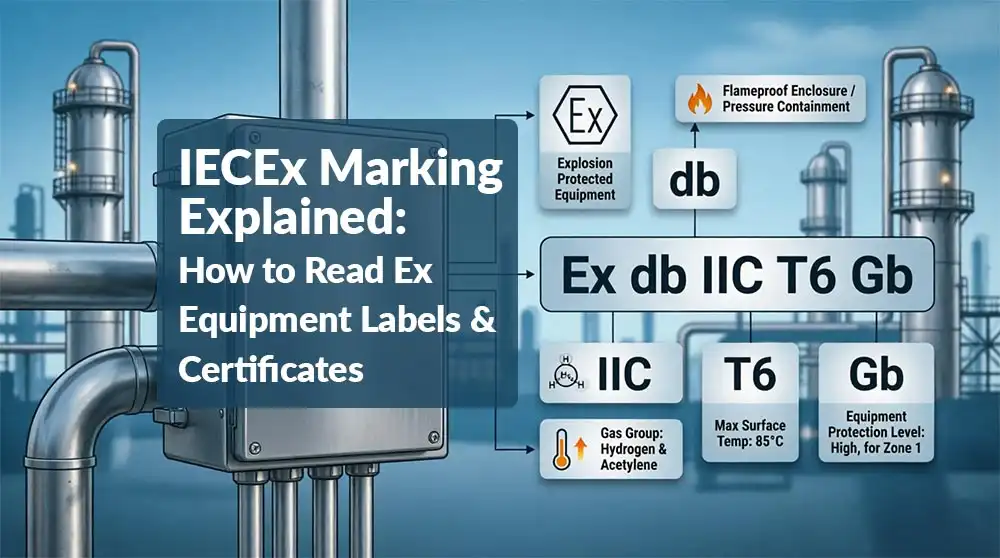
IECEx marking is a standardized code on explosion-protected equipment. It shows the protection type, gas or dust group, temperature class, and Equipment Protection Level (EPL). A marking like Ex db eb IIC T4 Gb IP66 gives you everything you need to confirm a piece of equipment is safe for its hazardous area zone.
What Is IECEx Marking and Why Does It Matter?
Every explosion-protected equipment used in a hazardous area carries an Ex marking. This alphanumeric code follows the IEC 60079 series of standards. Plant engineers, procurement officers, and HSE professionals use it to confirm equipment is safe for its intended zone.
IECEx marking is not decorative. It tells you exactly how equipment is protected against igniting an explosive atmosphere. Install the wrong equipment in the wrong zone, and you risk catastrophic failure. A device rated for Zone 2 must never go into a Zone 0 area — no paperwork can fix that mistake after an incident.
The International Electrotechnical Commission (IEC) administers the IECEx system. It aligns with IEC 60079-0, the main standard for equipment used in explosive atmospheres. Knowing what each part of an Ex marking means is a core skill for anyone who works with or buys hazardous area equipment in the UAE, GCC, or globally.
This guide breaks down every element of an Ex marking, explains protection types and gas groups, and shows you how to verify certificates. By the end, you’ll be able to read any Ex label with confidence.
Anatomy of an Ex Marking Code — Full Breakdown
| Element | Symbol | Meaning |
| Ex prefix | Ex | Equipment meets IEC 60079 explosive atmosphere standards |
| Primary protection type | d | Flameproof enclosure — contains internal ignition (Ex d) |
| Protection modifier | b | EPL “b” level applied to Ex d (i.e., EPL Gb) |
| Secondary protection type | e | Increased safety — prevents arcs, sparks, and excess heat |
| Protection modifier | b | EPL “b” level applied to Ex e |
| Gas group | IIC | Rated for the most hazardous gases, including hydrogen and acetylene |
| Temperature class | T4 | Max surface temperature of 135°C |
| Equipment Protection Level | Gb | Suitable for Zone 1 gas atmospheres |
| Ingress Protection | IP66 | Dust-tight; protected against powerful water jets |
What Do Protection Types Mean?
The protection type tells you how the equipment prevents igniting an explosive atmosphere. IEC 60079-0 defines several protection concepts, each suited to different applications.
Ex d — Flameproof Enclosure
Any internal ignition stays contained inside a strong enclosure. The enclosure is built to withstand an internal explosion and stop flames from spreading. Common applications: motors, junction boxes, switchgear.
Ex e — Increased Safety
No sparks or arcs are produced under normal conditions. Design measures — like wider creepage distances and tighter terminals — reduce ignition risk. Common applications: terminal boxes and luminaires.
Ex i — Intrinsic Safety
Electrical energy in the circuit is kept too low to ignite an explosive atmosphere, even if a fault occurs. Ex ia tolerates two faults; Ex ib tolerates one. Common applications: instruments and sensors in Zone 0 and Zone 1.
Ex n — Non-Sparking (Zone 2 Only)
Equipment that produces no sparks, arcs, or hot surfaces in normal operation. Suitable only for Zone 2, where explosive atmospheres are unlikely.
Ex p — Pressurization
The enclosure is kept at positive pressure, stopping flammable gases from entering. Common applications: large control panels and analyzers.
Ex t — Dust Ignition Protection by Enclosure
An enclosure stops dust from reaching ignition sources and controls surface temperature. The main protection concept for dust hazardous areas under IEC 60079-31.
Ex m — Encapsulation
Ignition sources are sealed in a compound, blocking contact with the explosive atmosphere. Common applications: small electronic components and sensors.
A single marking can show multiple protection types — like Ex db eb — meaning different parts of the equipment use different protection methods.
Understanding Gas Groups (IIA, IIB, IIC) and Dust Groups (IIIA, IIIB, IIIC)
Gas Groups — Explosive Gas Atmospheres (Group II)
| Gas Group | Representative Gas | Typical Applications |
| IIA | Propane | Refineries, LPG storage, general oil & gas |
| IIB | Ethylene | Chemical plants, ethylene processing |
| IIC | Hydrogen / Acetylene | Hydrogen generation, specialty chemical plants |
Dust Groups — Explosive Dust Atmospheres (Group III)
| Dust Group | Type of Dust | Examples |
| IIIA | Combustible flyings (fibers) | Wood dust, cotton fibers |
| IIIB | Non-conductive dust | Grain dust, plastic powder |
| IIIC | Conductive dust | Aluminum powder, magnesium dust |
What Is a Temperature Class (T-Rating)?
T-Rating Reference Table
| Temperature Class | Max Surface Temperature | Notes |
| T1 | 450°C | For gases with high ignition temperatures |
| T2 | 300°C | Covers a wide range of hydrocarbons |
| T3 | 200°C | Common in oil & gas applications |
| T4 | 135°C | Standard for motors and junction boxes |
| T5 | 100°C | For specific low-AIT gases only |
| T6 | 85°C | Most restrictive; for gases like carbon disulfide |
What Do Equipment Protection Levels (Ga, Gb, Gc / Da, Db, Dc) Mean?
Gas Atmosphere EPLs
| EPL | Zone | Protection Level | Description |
| Ga | Zone 0 | Very High | Safe even with two independent faults |
| Gb | Zone 1 | High | Safe even with one independent fault |
| Gc | Zone 2 | Enhanced | Safe during normal operation |
Dust Atmosphere EPLs
| EPL | Zone | Protection Level | Description |
| Da | Zone 20 | Very High | For areas where dust is continuously present |
| Db | Zone 21 | High | For areas where dust is likely in normal operation |
| Dc | Zone 22 | Enhanced | For areas where dust is unlikely in normal operation |
How to Verify an IECEx Certificate Is Genuine
Before installing any Ex-marked equipment, confirm the certificate is valid and current. The IECEx system has a free, public online database for this.
Steps to verify an IECEx certificate:
- Go to the IECEx Certificate Database at iecex.com/iecex-online/
- Enter the certificate number from the equipment label (e.g., IECEx DEK 21.0012X)
- Check the status — it must show “In Force”
- Confirm the protection types, gas group, T-rating, and EPL match the label
- Verify the equipment description matches the actual model
A “Withdrawn” or “Cancelled” certificate means the equipment has lost its IECEx approval. Do not install it. If a certificate number ends in “X”, it contains Special Conditions for Safe Use. Download the full certificate and read those conditions before installation.
If the certificate number doesn’t appear in the database, treat the equipment as uncertified. Resolve the issue with the manufacturer or a certified body before proceeding.
For equipment that has been repaired or refurbished, any significant repair must be done by an IECEx certified repair facility to keep the certification valid.
Common Mistakes When Reading Ex Markings — and Why They're Dangerous
Even experienced engineers misread Ex markings. Here are the most common — and most dangerous — errors seen across oil & gas and petrochemical sites in the GCC.
Ignoring EPL and Checking Only the Zone
Both EPL and zone must match. Equipment labeled Gc is rated for Zone 2 only. Installing it in a Zone 1 location is a compliance failure — regardless of what was intended at purchase.
Using IIA Equipment in an IIB or IIC Atmosphere
Gas groups are not interchangeable. IIA equipment is tested against propane, not hydrogen or ethylene. Installing it in an IIC atmosphere is a potentially fatal mismatch.
Missing the “X” Suffix on a Certificate Number
A certificate ending in “X” (e.g., IECEx DEK 21.0012X) has Special Conditions for Safe Use. These are not on the label. Skipping them invalidates the protection — completely.
Misreading Combined Protection Types
Ex db eb means two separate protection concepts apply to two different parts of the equipment. Some engineers treat this as a single method. That leads to wrong installation steps and wrong maintenance schedules.
Accepting Unofficial or Photocopied Certificates
Counterfeit and expired certificates are a real procurement risk. Always check the IECEx online database directly. If a certificate only exists as a scanned PDF and can’t be found online, treat it as invalid.
Selecting Equipment by T-Class Alone
T-class must match the AIT of the specific gas present. A gas with an AIT of 160°C needs T4-rated equipment (max surface 135°C) or better. Using T3-rated equipment (max 200°C) in that atmosphere creates an active ignition source.
How ATEX-IECEx (Kingsmen Group) Helps You Verify and Certify Equipment Markings
ATEX-IECEx, part of Kingsmen Group, offers technical consultancy and certification support for hazardous area equipment and personnel. We work with plant engineers, HSE officers, procurement teams, and maintenance staff across the UAE (Dubai and Abu Dhabi), Qatar, Saudi Arabia, and India.
Our services include:
- Ex marking audits — checking equipment labels against area classification drawings and IECEx certificates
- Certificate verification — confirming markings against the IECEx database; identifying withdrawn, expired, or X-suffixed certificates
- Technical clarification — interpreting complex multi-protection markings, EPL-to-zone checks, and gas group reviews
- Procurement advisory — helping you specify equipment that is correctly rated before purchase
- Documentation review — aligning equipment schedules, area classification reports, and Ex registers to IEC 60079-0
Our work supports the broader IECEx certification process — making sure every piece of equipment in your facility carries accurate, verifiable markings suited to its environment. If you source equipment from European suppliers, we also advise on the differences between IECEx and ATEX standards. See our guide on ATEX vs IECEx key differences for more.
Read Every Ex Label Right — Every Time
Misreading an Ex marking is not a minor error. In a Zone 0 or Zone 1 environment, the wrong equipment can cause serious harm. Knowing how to read IECEx marking — protection type, gas group, T-rating, EPL — is a non-negotiable skill for anyone working in hazardous areas.
Use this guide as your reference. Match your equipment’s marking to your site’s area classification and the substances listed in your hazardous area study.
Need help verifying or certifying your equipment markings? Talk to our IECEx experts.
ATEX-IECEx (Kingsmen Group) supports facilities across the UAE, Qatar, Saudi Arabia, and India with IEC 60079-compliant marking audits and certification services. Contact our team to get started.
Frequently Asked Questions
What does IECEx marking mean?
IECEx marking is a standardized code on explosion-protected equipment, defined by IEC 60079-0. It tells you the protection type, gas or dust group, max surface temperature (T-rating), and Equipment Protection Level (EPL). A marking like Ex db eb IIC T4 Gb IP66 gives you all the information needed to confirm safe use in a specific hazardous zone.
How do I check if an IECEx certificate is valid?
Go to iecex.com/iecex-online and search by certificate number. A valid certificate shows “In Force.” Check that the protection type, gas group, T-rating, and EPL on the certificate match the equipment label. If the number ends in “X”, download the certificate and read the Special Conditions before installation.
What is the difference between Ex d and Ex e protection?
Ex d (flameproof) contains any internal explosion inside a strong enclosure, stopping flames from spreading outward. Ex e (increased safety) prevents ignition sources from forming in the first place — through tighter design tolerances and stricter temperature limits. Both types are often combined in the same equipment, shown as Ex db eb.
What does the “X” suffix on an IECEx certificate number mean?
It means the certificate includes Special Conditions for Safe Use. These are specific installation, maintenance, or operation requirements that must be followed for the protection to remain valid. They are not on the equipment label — download the full certificate from the IECEx database to read them.
Can I use IIC-rated equipment in an IIA gas atmosphere?
Yes. IIC is the most stringent gas group, so IIC-rated equipment is safe for IIB and IIA atmospheres too. The reverse is not allowed — IIA equipment must never be used in IIB or IIC atmospheres. Always match or exceed the gas group of your site’s classification.
What is the difference between EPL Gb and Zone 1?
Zone 1 describes the location — an area where explosive gas is likely during normal operation. EPL Gb describes the equipment — it provides high protection suitable for Zone 1. You must match them. Equipment rated Gc (Zone 2) cannot be used in a Zone 1 location, even if other parameters look right.